Insights / Product Marketing
What Is Product Marketing? Definition, Strategy and Examples
A practical, full-lifecycle guide to what product marketing is, what product marketers do, how the process works, and how the discipline differs from product management and broader marketing.

What is product marketing? It is the cross-functional discipline that determines who a product is for, why those customers should choose it, and how its value will be brought to market, adopted, and sustained.
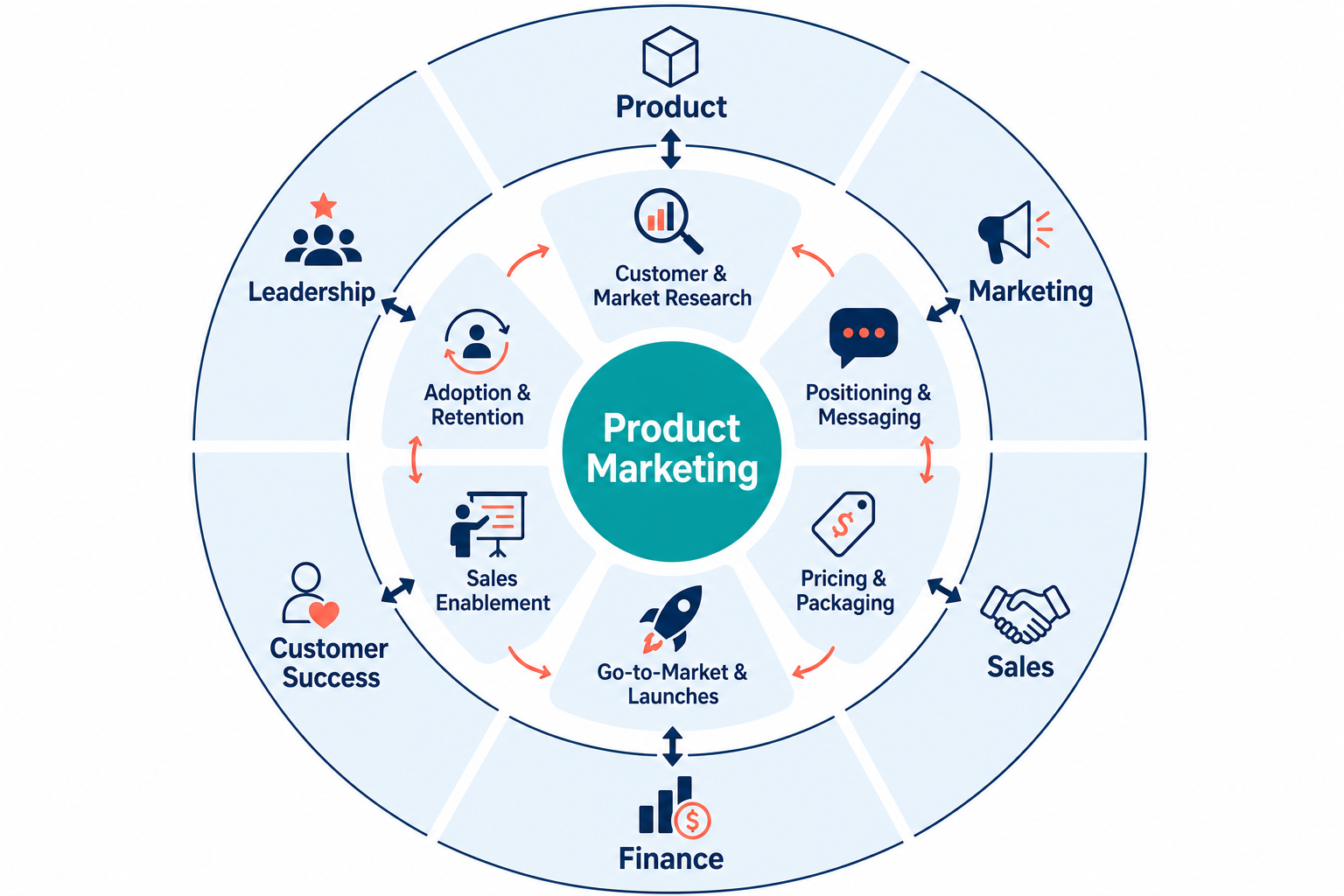
That makes product marketing much broader than advertising a product or coordinating a launch. It connects customer research, competitive intelligence, positioning, messaging, pricing, go-to-market strategy, sales enablement, adoption, and retention.
A product marketer listens to the market and helps the company make better product and commercial decisions. Then, the product marketer translates what the product can do into a clear reason for customers to care.
Applying these principles to a complex technical product? Explore CaliberUp’s product marketing services for positioning, messaging, go-to-market strategy, launches, and sales enablement.
The short answer: Product marketing connects what a company builds with what its market needs. It turns customer evidence into decisions and product capabilities into buyer value.
What Is Product Marketing? A Clear Definition
A practical product marketing definition is:
Product marketing is the full-lifecycle discipline responsible for understanding a market, defining how a product should be positioned, enabling its go-to-market strategy, and improving its adoption and commercial performance.
It sits at the intersection of product management, marketing, sales, and customer success. Depending on the company, product marketers may also influence pricing, packaging, product strategy, onboarding, competitive intelligence, and customer research.
The function can look different across organizations. A startup product marketer might handle everything from interviews and website copy to sales training. At a larger company, one product marketer might specialize in launches while another focuses on competitive intelligence, a specific customer segment, or an entire product portfolio.
The common thread is accountability for the relationship between a product and its market.
Product marketing in one sentence
Product marketing determines who a product is for, why they should choose it, and how the company will communicate and deliver that value throughout the product lifecycle.
That definition contains three essential decisions:
- Who is the customer? This includes the target market, ideal customer profile, buyer personas, users, decision-makers, and influencers.
- Why should they choose the product? This requires a differentiated value proposition supported by credible proof.
- How will the product reach and retain those customers? This includes go-to-market strategy, messaging, channels, sales enablement, onboarding, adoption, and retention.
Product marketing is therefore not synonymous with promotion. Promotion distributes a message. Product marketing helps decide what the message should be, whom it should address, whether the underlying product supports it, and how success will be measured.
Product marketing is a two-way translation system
The clearest way to understand product marketing is as a two-way translation system.
In one direction, product marketing translates market evidence into company decisions. Customer interviews, sales conversations, win-loss analysis, competitor changes, support themes, and usage data can influence positioning, pricing, packaging, roadmap priorities, and go-to-market plans.
In the other direction, product marketing translates product capabilities into customer value. Features become outcomes. Technical language becomes a buyer-relevant narrative. Product releases become compelling reasons to adopt, buy, upgrade, or stay.
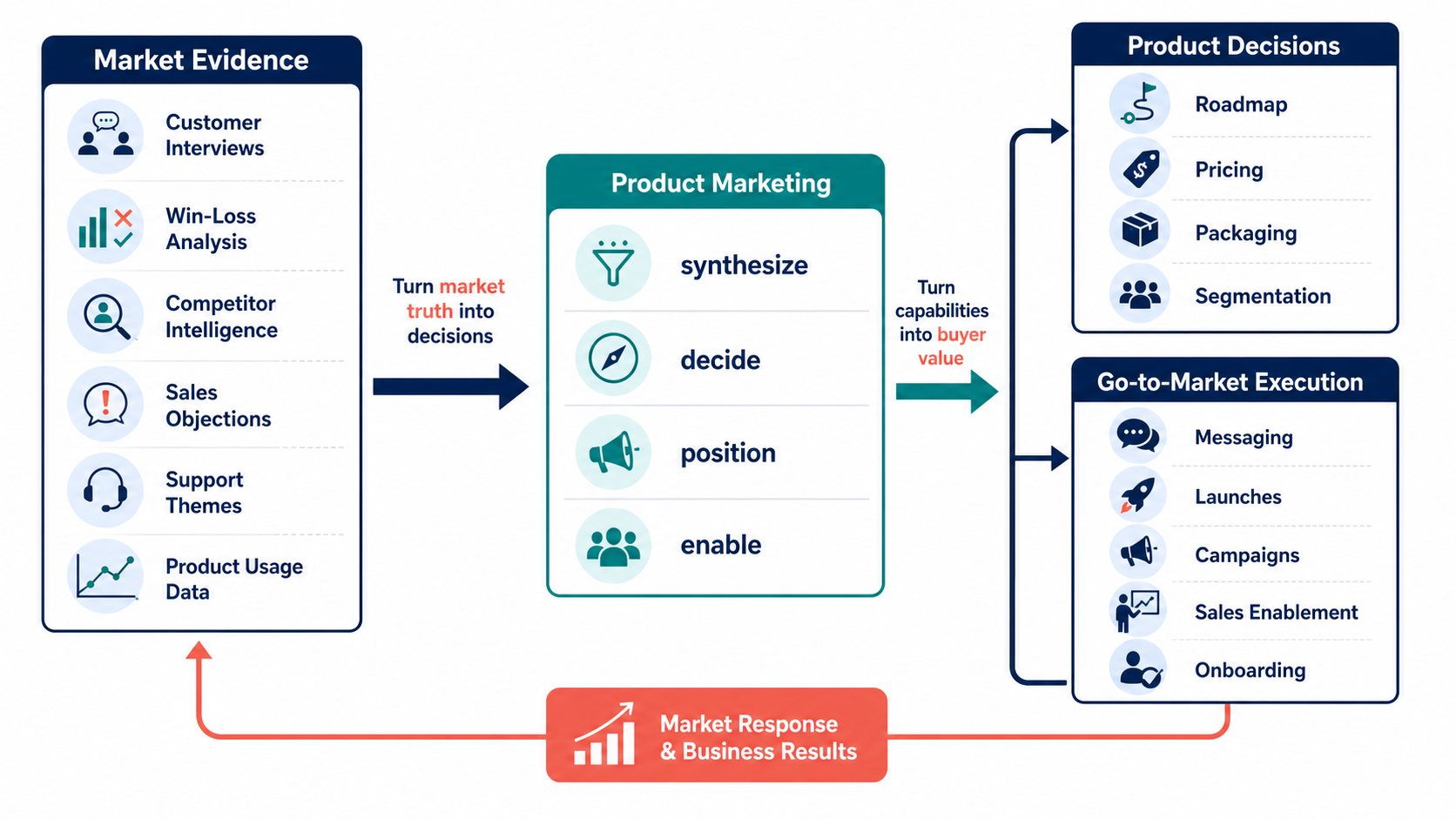
The loop should never stop after launch. Market response produces new evidence, which informs the next set of product and commercial decisions.
Why Is Product Marketing Important?
Product marketing reduces the risk of building, launching, or promoting something the market does not understand or value.
A strong product alone does not guarantee success. Customers must recognize the problem it solves, believe its claims, understand how it differs from alternatives, and experience the promised value after they buy it.
Product marketing creates the evidence, narrative, and organizational alignment required to make that happen.
It helps companies build for real market needs
Organizations naturally develop internal assumptions about what customers want. Those assumptions can be shaped by executive preferences, individual sales requests, competitor releases, or excitement about new technology.
Product marketers challenge those assumptions with evidence.
They interview customers, examine why deals are won or lost, analyze alternatives, monitor changing buyer priorities, and look for patterns across qualitative and quantitative data. Their job is not simply to collect comments. It is to distinguish a repeatable market need from an isolated request.
This research can help answer questions such as:
- Is the problem important enough for customers to act?
- Which segment experiences it most acutely?
- How are customers solving it today?
- What prevents them from changing?
- What outcome would make a new solution valuable?
- Which capabilities are essential, and which are merely attractive?
- What proof would customers need before buying?
When these answers reach product teams early, product marketing can improve product-market fit before significant launch resources are committed.
It turns features into differentiated value
Customers rarely buy a product because it contains the longest list of features. They buy because they expect it to produce a meaningful outcome with an acceptable level of cost, effort, and risk.
Product positioning and messaging bridge that gap.
Suppose a software platform includes automated anomaly detection. The feature describes what the product does. Its customer value might be that an operations manager can identify a costly problem before it disrupts the business.
The difference matters:
- Feature: Automated anomaly detection.
- Functional benefit: Finds unusual activity without manual monitoring.
- Business outcome: Reduces the likelihood that operational problems go unnoticed.
- Differentiated value: Gives lean operations teams earlier warning without requiring a dedicated analyst.
Product marketing turns the feature into a relevant, credible reason to choose the product.
It aligns product, marketing, sales, and customer success
A product’s story can fragment quickly.
The website may promise simplicity while sales focuses on customization. Product managers may emphasize technical innovation while customers care about faster implementation. Customer success may describe the product differently from the team that sold it.
These inconsistencies weaken trust and make it harder for customers to understand the product.
Product marketing creates a shared foundation that can include:
- A defined ideal customer profile.
- Agreed customer problems and use cases.
- A positioning statement.
- A messaging hierarchy.
- Differentiated value propositions.
- Competitive talking points.
- Approved proof and customer evidence.
- Clear launch objectives.
- Guidance for different audiences and channels.
This foundation does not require every team to use identical language. It ensures that each team communicates the same underlying value.
It supports adoption, retention, and expansion
Product marketing does not end when the launch announcement is published.
The value promised before purchase must also be experienced after purchase. If customers do not reach that value, weak adoption and retention can erase the gains from an otherwise successful launch.
Post-launch product marketing may include:
- Improving onboarding messages.
- Promoting underused capabilities.
- Segmenting adoption campaigns.
- Explaining new features.
- Collecting customer proof.
- Studying churn and renewal objections.
- Supporting cross-sell and expansion.
- Repositioning a product as the market changes.
This is why awareness alone is not an adequate measure of product marketing. The function should ultimately contribute to valuable customer behavior and sustainable business results.
What Does Product Marketing Do?
What does product marketing do in practice? Its responsibilities usually span six connected areas: research, positioning, commercial strategy, go-to-market execution, enablement, and post-launch growth.
The exact product marketing responsibilities depend on the business model, product maturity, team structure, and market. The following activities represent the function’s most common strategic scope.
Customer and market research
Customer and market research gives product marketing its foundation.
Common research inputs include:
- Customer and prospect interviews.
- Buyer surveys.
- Sales call recordings.
- Win-loss interviews.
- Support requests and customer success notes.
- Product analytics.
- Review sites and community discussions.
- Competitor products, websites, pricing, and messaging.
- Industry reports and category trends.
Product marketers synthesize these sources to define patterns. A useful research finding does more than state that customers want a feature. It explains which customers experience a problem, why the problem matters, how they solve it now, what triggers a purchase, and what might prevent adoption.
Research outputs can include an ideal customer profile, buyer personas, jobs-to-be-done, market segmentation, competitive intelligence, buyer journey maps, and problem-priority analyses.
Positioning, messaging, and value propositions
Positioning and messaging are related, but they are not interchangeable.
Positioning defines the place a product should occupy in the mind of a target customer relative to alternatives. It answers:
- Who is the product for?
- What important problem does it solve?
- What category or frame of reference helps customers understand it?
- What makes it meaningfully different?
- Why should customers believe the claim?
Messaging turns that positioning into a structured system of communication. It may include a primary value proposition, supporting benefits, proof points, audience-specific variations, objection responses, and examples.
A positioning statement is primarily an internal strategic tool. A messaging hierarchy helps teams express that strategy externally across landing pages, campaigns, presentations, product tours, sales conversations, and customer communications.
Pricing and packaging research
Pricing determines more than what a customer pays. It communicates value, shapes the target market, influences sales complexity, and affects how customers compare alternatives.
Product marketers may support pricing and packaging by researching:
- Willingness to pay.
- Customer perceptions of value.
- Common product combinations.
- Competitor pricing structures.
- Preferred billing units.
- Feature or usage thresholds.
- Good-better-best packaging.
- Upgrade triggers.
- Discount expectations.
- Sources of pricing confusion.
Final authority may belong to executive leadership, finance, or product management. Product marketing’s contribution is market evidence: how buyers perceive the offer and how different choices could affect positioning, acquisition, adoption, or expansion.
Go-to-market strategy and product launches
A go-to-market strategy defines how a company will introduce an offer, reach the right customers, and create the conditions for adoption and revenue.
It typically covers:
- Target audience and priority segments.
- Customer problem and use cases.
- Positioning and messaging.
- Pricing and packaging.
- Sales or distribution motion.
- Marketing channels.
- Launch tier and timeline.
- Internal readiness.
- Customer onboarding.
- Success metrics.
- Risks, dependencies, and feedback mechanisms.
Product launches are visible expressions of this strategy, but not every release deserves the same level of investment. Product marketers often classify launches by expected customer and business impact.
A small feature update might require release notes, in-product education, and a customer email. A major product launch could require months of research, a new website narrative, analyst briefings, sales certification, partner enablement, events, campaigns, and executive communication.
Sales and partner enablement
Sales enablement helps customer-facing teams identify suitable buyers, explain value, handle objections, and compete consistently.
Product marketing deliverables may include:
- Sales presentations.
- Discovery questions.
- Product one-pagers.
- Competitive battlecards.
- Objection-handling guides.
- Demo narratives.
- Industry or persona playbooks.
- Customer stories.
- ROI tools.
- Partner training.
- Launch certification.
Producing an asset is only the beginning. Product marketers should also verify that sales teams understand it, trust it, use it, and can apply it in real conversations.
That requires feedback. Which objections are becoming more common? Where do deals stall? Which competitors appear most often? What proof is missing? The answers feed back into positioning, content, enablement, and sometimes the product itself.
Adoption, retention, and lifecycle marketing
Post-launch product marketing focuses on helping customers recognize and realize ongoing value.
This work can include:
- Onboarding sequences.
- Activation campaigns.
- Feature education.
- In-product announcements.
- Use-case expansion.
- Customer advocacy.
- Renewal support.
- Cross-sell and upsell messaging.
- Churn analysis.
- Repositioning mature products.
The emphasis shifts from “Why should I buy?” to “How do I achieve value?” and eventually to “Why should I stay, expand, or advocate?”
A strong product story should remain consistent across these stages while adapting to the customer’s changing needs.
The Product Marketing Process: A Full-Lifecycle Framework
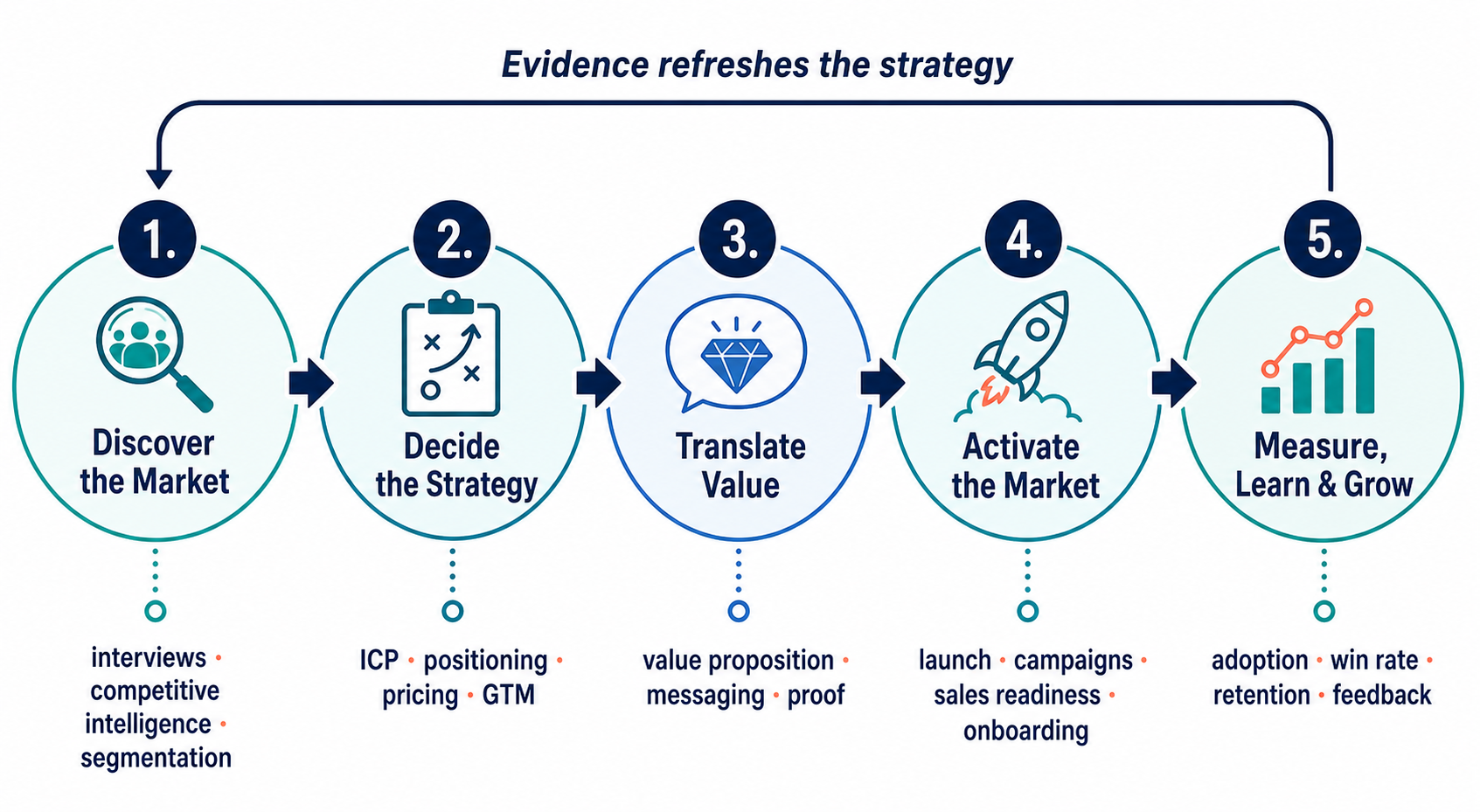
The product marketing process can be organized into five stages:
- Discover the market.
- Decide the strategy.
- Translate value into messaging.
- Activate the market.
- Measure, learn, and grow.
These stages are sequential enough to provide structure but flexible enough to support continuous iteration. Research does not stop when positioning begins, and messaging does not become permanent after launch.
1. Discover the market
The discovery stage replaces internal assumptions with a defensible market hypothesis.
Product marketers gather customer, competitor, and business evidence to understand:
- The market problem.
- The segments most affected.
- Existing alternatives.
- Buyer priorities.
- Purchase triggers.
- Decision criteria.
- Adoption barriers.
- Category dynamics.
The goal is not to accumulate research. It is to identify the insights that should change a decision.
Key outputs may include:
- Ideal customer profile.
- Buyer and user personas.
- Market segmentation.
- Jobs-to-be-done.
- Competitor map.
- Buyer journey.
- Win-loss themes.
- Problem and opportunity brief.
A discovery stage is complete enough to proceed when the team can describe a high-priority customer, an important problem, the customer’s alternatives, and a credible opportunity to deliver distinct value.
2. Decide the strategy
The strategy stage turns research into choices.
A product cannot be positioned as the ideal solution for every possible customer. Product marketing strategy requires deciding which segments matter most, what value to emphasize, which alternatives to compete against, and how the product will reach its market.
Strategic decisions may include:
- Primary and secondary customer segments.
- Category and competitive frame.
- Positioning direction.
- Priority use cases.
- Pricing and packaging hypotheses.
- Go-to-market motion.
- Launch objectives.
- Channel priorities.
- Commercial goals.
- Evidence required to support the strategy.
A strong strategy is as clear about what the company will not prioritize as it is about what it will pursue.
3. Translate value into messaging
The translation stage converts strategy into language that internal teams and customers can use.
A messaging hierarchy often begins with one central value proposition and expands into:
- Customer problem.
- Desired outcome.
- Differentiated benefits.
- Supporting product capabilities.
- Proof points.
- Persona-specific messages.
- Industry-specific messages.
- Objection responses.
- Competitive distinctions.
- Calls to action.
The strongest messaging is specific enough to be memorable but flexible enough to work across channels.
It should also be tested. Product marketers can evaluate whether target customers understand the message, consider it relevant, believe the claims, and perceive meaningful differentiation.
4. Activate the market
Activation turns product marketing strategy into coordinated execution.
Before a launch or campaign, product marketing should confirm that:
- The product is ready for the intended audience.
- The target segment is clearly defined.
- Messaging has been approved and tested.
- Sales and support teams are prepared.
- Campaign teams have usable briefs.
- Customer-facing assets are consistent.
- Onboarding supports the promised value.
- Measurement and feedback systems are in place.
Activation may include a launch, but it can also involve repositioning an existing product, entering a new segment, responding to a competitor, changing pricing, or increasing adoption of an underused capability.
5. Measure, learn, and grow
The final stage tests the assumptions behind the strategy.
Product marketers should compare results with a documented baseline or target. They should also determine why performance changed rather than merely reporting that it changed.
Questions include:
- Did the intended audience engage?
- Did buyers understand the value proposition?
- Was sales prepared to tell the story?
- Did win rates or sales velocity change?
- Did users activate and adopt the product?
- Which objections or friction points appeared?
- Did the product deliver the promised outcome?
- What should change in the messaging, experience, or roadmap?
The answers begin the next cycle of discovery.
Product Marketing vs Product Management vs Marketing
Product marketing overlaps with several functions, which is one reason the role is frequently misunderstood.
The clearest distinctions are based on each function’s primary decisions and outcomes—not on rigid lists of tasks.
| Function | Primary question | Typical ownership | Primary outcomes |
|---|---|---|---|
| Product marketing | Why should this market choose and adopt the product? | Market intelligence, positioning, messaging, GTM readiness, enablement | Differentiation, adoption, win rate, revenue, retention |
| Product management | What should be built and why? | Product vision, roadmap, prioritization, requirements | Product value, usability, delivery, product outcomes |
| Traditional marketing | How will the company build awareness and demand? | Brand, audiences, channels, campaigns, communications | Reach, engagement, demand, brand preference |
| Demand generation | How will qualified demand be created and converted? | Acquisition programs, campaign operations, funnel performance | Leads, pipeline, acquisition, conversion |
| Content marketing | What useful content will attract and educate an audience? | Editorial strategy, content production, distribution | Organic visibility, engagement, audience growth, demand |
| Customer success | How will customers realize and expand value? | Onboarding, adoption support, renewals, account health | Time to value, retention, expansion, advocacy |
Product marketing vs product management
Product management primarily decides what should be built, why it should be built, and how product work should be prioritized.
Product marketing primarily determines how the product should connect with its market: whom it should serve, how it should be positioned, what buyers need to understand, and how the organization will bring it to market.
The two roles should not operate in isolation.
Product managers contribute technical knowledge, usage insight, product vision, and delivery context. Product marketers contribute market intelligence, buyer insight, commercial context, and competitive understanding.
Their responsibilities often overlap in customer research, pricing, launches, and roadmap discussions. Effective teams define who is accountable for the final decision while allowing both roles to contribute evidence.
Product marketing vs traditional marketing
Traditional marketing usually operates at a broader company, brand, or audience level. It may be responsible for brand awareness, communications, demand generation, channel strategy, events, advertising, social media, and corporate reputation.
Product marketing concentrates on the success of a particular product, portfolio, segment, or use case.
Traditional marketing might ask, “How can we increase awareness among operations leaders?”
Product marketing might ask, “Which operational problem is urgent enough to make those leaders replace their current solution, and what evidence would make our product the preferred choice?”
Both functions support growth. Product marketing supplies product-specific market strategy and narrative; broader marketing functions help activate that strategy at scale.
Product marketing vs demand generation and content marketing
Demand generation runs programs intended to create and convert qualified interest. Content marketing attracts and educates audiences through useful information.
Product marketing gives these functions a strategic foundation.
It can define:
- Priority audience.
- Customer problem.
- Category context.
- Value proposition.
- Differentiated benefits.
- Competitive alternatives.
- Proof points.
- Objections.
- Use cases.
- Launch or campaign objectives.
Demand generation then designs programs to reach and convert that audience. Content marketing develops resources that address its questions and build trust.
In practice, the teams collaborate. Product marketing should not dictate every channel decision, and channel teams should not have to invent the product’s positioning independently.
Where ownership overlaps
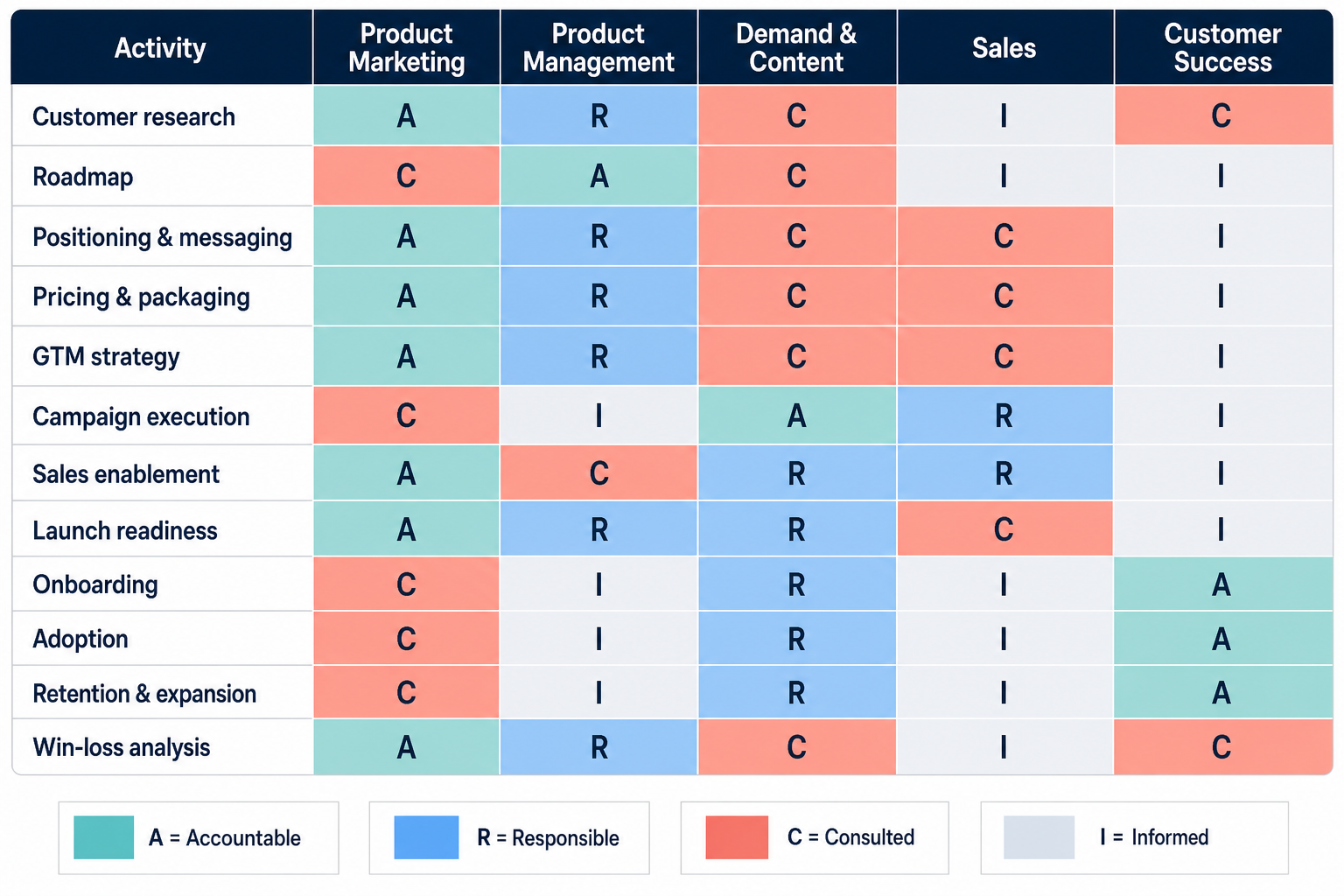
A RACI matrix can reduce confusion:
- A — Accountable: Owns the final outcome or decision.
- R — Responsible: Performs or coordinates the work.
- C — Consulted: Contributes evidence or expertise.
- I — Informed: Kept aware of the decision or result.
The following is an illustrative model. Actual ownership should reflect the organization’s structure.
| Activity | Product marketing | Product management | Demand/content | Sales | Customer success |
|---|---|---|---|---|---|
| Customer and market research | A/R | R | C | C | C |
| Product roadmap | C | A/R | I | C | C |
| Positioning and messaging | A/R | C | C | C | C |
| Pricing and packaging research | A/R | R | I | C | C |
| Go-to-market strategy | A/R | C | R | R | C |
| Campaign execution | C | I | A/R | C | I |
| Sales enablement | A/R | C | I | R | I |
| Launch readiness | A/R | R | R | R | R |
| Customer onboarding | C | C | I | I | A/R |
| Adoption programs | R | C | C | I | A/R |
| Retention and expansion | R | C | C | R | A/R |
| Win-loss analysis | A/R | C | I | C | C |
Product Marketing Deliverables by Lifecycle Stage
Product marketing becomes easier to understand when its responsibilities are connected to tangible deliverables.
The deliverable is not the ultimate goal. A messaging document, battlecard, or launch brief is valuable only when it improves a decision or customer outcome. Still, these artifacts help teams apply product marketing strategy consistently.
Before development or launch
Early-stage deliverables establish the market foundation:
- Customer research plan.
- Interview findings.
- Market and category analysis.
- Ideal customer profile.
- Buyer and user personas.
- Jobs-to-be-done.
- Buyer journey.
- Competitive landscape.
- Win-loss analysis.
- Problem or opportunity brief.
- Positioning statement.
- Pricing and packaging research.
- Go-to-market brief.
These deliverables should help product teams evaluate the opportunity and help commercial teams understand where the product can win.
During launch preparation
Launch-preparation deliverables translate the strategy into coordinated action:
- Messaging hierarchy.
- Value proposition.
- Product narrative.
- Launch tier and plan.
- Campaign brief.
- Website or landing-page copy.
- Product one-pager.
- Sales presentation.
- Competitive battlecards.
- Demo narrative.
- Objection-handling guide.
- FAQ.
- Internal training.
- Partner enablement.
- Customer onboarding messages.
- Measurement plan.
Each asset should reflect the same positioning while adapting its depth and language to its audience.
After launch
Post-launch deliverables support learning and growth:
- Launch performance review.
- Adoption dashboard.
- Customer feedback synthesis.
- Updated competitive intelligence.
- Win-loss findings.
- Sales feedback report.
- Churn or renewal analysis.
- Feature-adoption campaign.
- Customer case study.
- Messaging revision.
- Repositioning recommendation.
- Roadmap insight brief.
This stage is where product marketing proves that it is a lifecycle function rather than a launch service.
How to Measure Product Marketing Success
Product marketing metrics should reflect the objective, product stage, and go-to-market motion.
No single metric can capture the entire function. Revenue matters, but many teams contribute to it. Asset production is easy to count, but it does not prove that the assets influenced behavior.
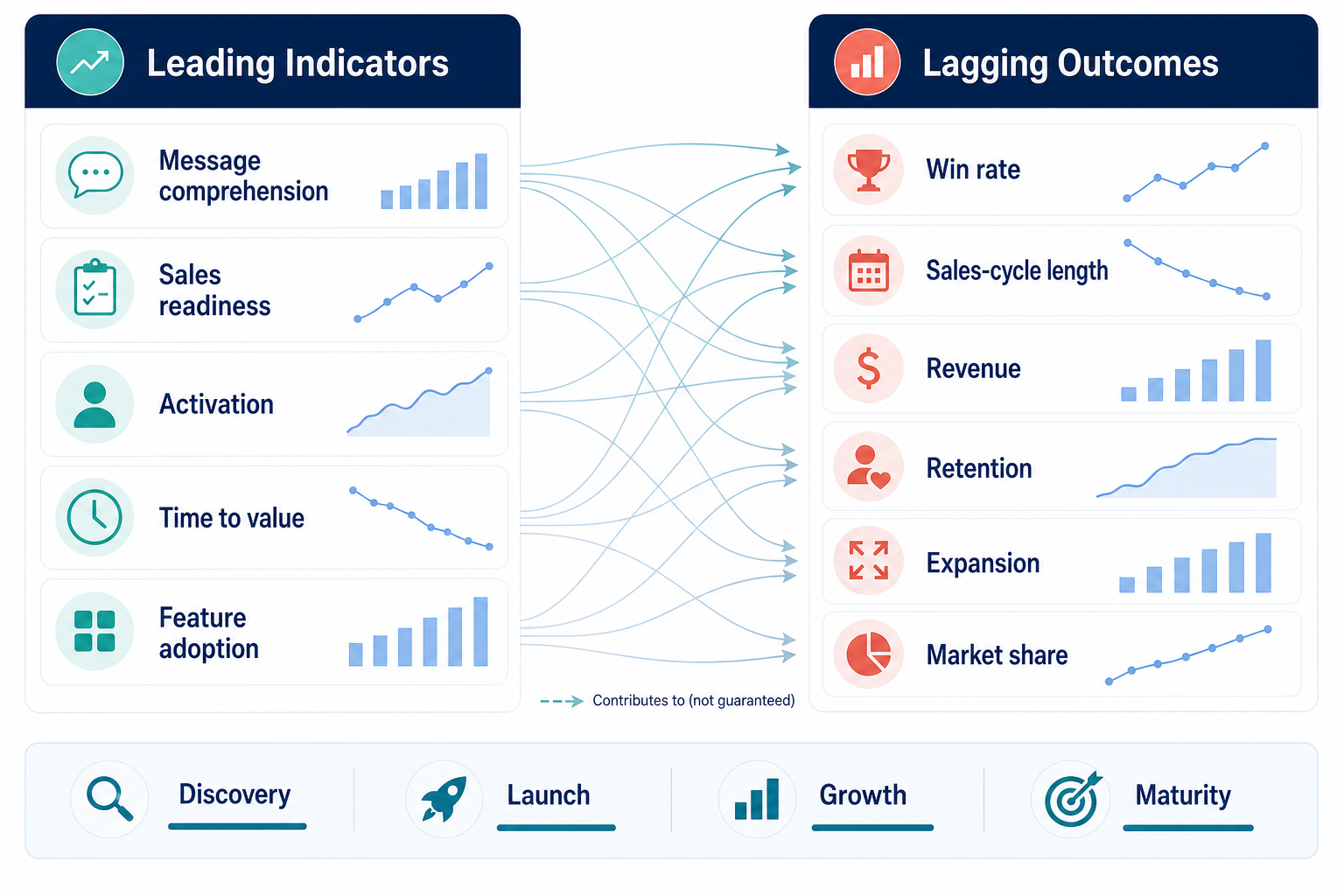
The best measurement system combines leading indicators, lagging outcomes, and qualitative evidence.
Leading indicators
Leading indicators show whether the conditions for future success are improving.
Examples include:
- Message comprehension: Can target buyers accurately explain what the product does and why it matters?
- Message preference: Does the new value proposition outperform an alternative in testing?
- Sales readiness: Can representatives identify the audience, explain the value, and respond to common objections?
- Enablement adoption: Are customer-facing teams using the new materials?
- Launch readiness: Have the required product, campaign, sales, support, and measurement dependencies been completed?
- Activation rate: What percentage of new users reaches the first meaningful product outcome?
- Time to value: How long does it take customers to experience that outcome?
- Feature adoption: Are target users engaging with the promoted capability?
- Product-qualified demand: Are high-intent users completing behaviors associated with purchase or expansion?
These measures can reveal problems before they appear in quarterly revenue or retention results.
Lagging indicators
Lagging indicators show commercial and customer outcomes that have already occurred.
They may include:
- Win rate.
- Competitive win rate.
- Sales-cycle length.
- Conversion rate.
- Average contract value.
- Product or feature revenue.
- Customer acquisition cost.
- Retention.
- Expansion revenue.
- Churn.
- Customer lifetime value.
- Market share.
Product marketers should avoid claiming sole credit for these outcomes. Instead, they should document their contribution.
For example, a repositioning project might be associated with better landing-page conversion, improved sales confidence, and a higher win rate in the target segment. Together, those signals make a stronger case than any one metric alone.
Match metrics to the product’s stage
Measurement priorities should change as the product matures.
| Product stage | Primary questions | Useful product marketing metrics |
|---|---|---|
| Discovery | Is the problem important and repeatable? | Interview patterns, problem severity, willingness to change, concept response |
| Early launch | Does the market understand and try the product? | Message comprehension, qualified interest, activation, time to value |
| Growth | Can the company acquire and convert efficiently? | Win rate, pipeline contribution, adoption, sales velocity, acquisition efficiency |
| Maturity | Can the product defend and expand its position? | Retention, expansion, competitive win rate, market share, feature adoption |
| Repositioning | Does the new narrative change perception and behavior? | Message preference, new-segment conversion, sales confidence, win-loss themes |
Product Marketing Example: From Insight to Growth
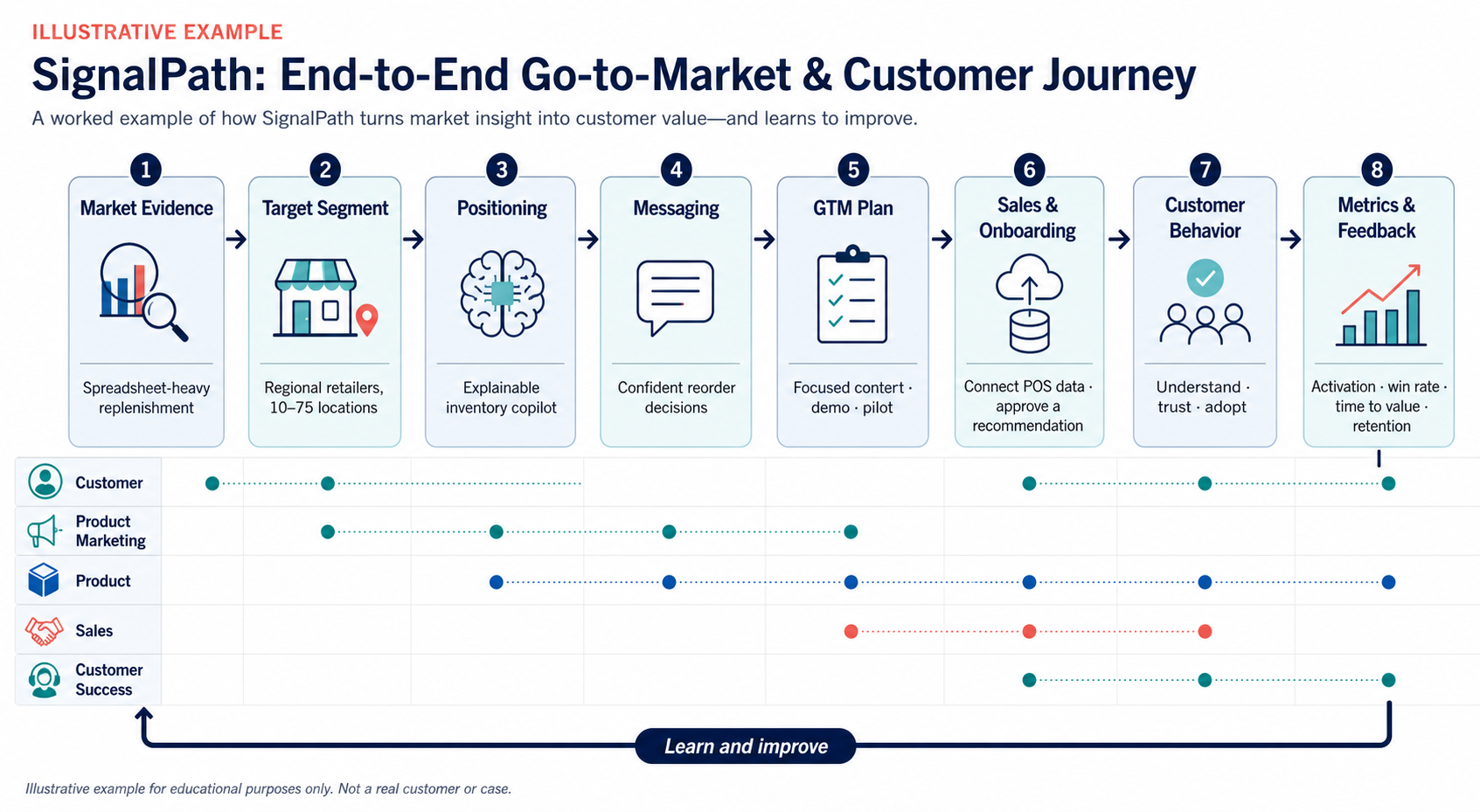
Consider a hypothetical B2B software company called SignalPath.
SignalPath offers inventory forecasting software for regional retailers. The product contains sophisticated predictive technology, but its original messaging emphasizes “AI-powered forecasting accuracy.”
The message sounds modern, yet sales are inconsistent and new users struggle to reach value.
The following example shows how product marketing could connect market insight to measurable improvement. All figures are illustrative.
The market insight
The product marketing team reviews sales calls, interviews customers, studies churned trials, and compares competitor messaging.
It discovers four patterns:
- Regional retailers spend hours exporting point-of-sale data into spreadsheets.
- Their main concern is not whether forecasting uses AI; it is whether managers can trust and act on the recommendation.
- Larger enterprise systems appear powerful but feel expensive and difficult to implement.
- Store managers need to understand why a reorder is recommended before approving it.
The original message—“AI-powered forecasting accuracy”—describes a capability but does not address the strongest buying criteria: speed, clarity, trust, and ease of implementation.
The team prioritizes retailers with 10–75 locations. These companies have enough inventory complexity to need forecasting but often lack dedicated data science and implementation teams.
The positioning and message
Based on that evidence, SignalPath adopts the following internal positioning:
For regional retailers managing inventory across multiple locations, SignalPath is an explainable inventory copilot that turns existing point-of-sale data into confident reorder decisions—without the cost and complexity of an enterprise planning system.
The primary message becomes:
Make confident inventory decisions without rebuilding your operations.
Supporting messages include:
- Connect existing point-of-sale data instead of replacing core systems.
- See why each reorder is recommended.
- Focus managers on exceptions rather than spreadsheet maintenance.
- Start with one region or product category before expanding.
The product marketer works with the product team to verify that the experience supports these claims. “Explainable” cannot remain a marketing adjective; the interface must show the factors behind a recommendation.
The go-to-market execution
SignalPath creates a focused go-to-market plan for regional retail operations leaders.
The plan includes:
- A landing page centered on explainable reorder decisions.
- A guide to replacing spreadsheet-based inventory planning.
- A savings calculator based on current manual effort and stock imbalances.
- A demo structured around one manager’s weekly workflow.
- A competitive battlecard addressing enterprise-suite complexity.
- A limited pilot for one region or product category.
- Sales training on the target segment and disqualifying conditions.
- An onboarding checklist that guides customers to connect data and approve their first recommendation.
Each asset supports the same positioning. The content attracts the right problem-aware audience, the sales narrative demonstrates the promised outcome, and onboarding helps customers experience that outcome.
The results and feedback loop
Before launch, SignalPath documents baseline performance. It then compares the target segment with previous results.
An illustrative quarterly review might show:
- Activation increased from 45% to 62%.
- Median time to first approved recommendation decreased from nine days to five.
- Win rate in the target segment increased from 21% to 28%.
- Sales representatives reported fewer objections about implementation complexity.
- New customers still requested clearer controls for regional exceptions.
The first four signals suggest that the new strategy is improving understanding and adoption. The final finding becomes a new input.
Product marketing shares the exception-control theme with product management, updates the demo to explain current controls accurately, and revises the roadmap evidence brief. The next product marketing cycle begins with better information than the previous one.
How Product Marketing Changes by Company and Business Model
The foundations of product marketing remain consistent, but execution changes according to the customer, product, buying process, and company structure.
A playbook designed for enterprise software will not map perfectly to consumer packaged goods. A startup’s first product marketer will not have the same role as a portfolio marketer at a global company.
B2B vs B2C product marketing
B2B product marketing often deals with:
- Multiple decision-makers.
- Longer buying cycles.
- Sales-led evaluation.
- Formal procurement.
- Security and integration requirements.
- Detailed business cases.
- Sales and partner enablement.
- Industry or role-specific messaging.
A B2B product marketer may create messaging for an executive sponsor, a technical evaluator, a procurement team, and an end user—all involved in the same purchase.
B2C product marketing often places greater emphasis on:
- Consumer behavior.
- Emotional and functional benefits.
- Pricing psychology.
- Retail or digital distribution.
- Merchandising.
- Packaging.
- High-volume acquisition.
- Repeat purchase and loyalty.
- Cultural and seasonal trends.
The difference is not that B2B is rational and B2C is emotional. Both involve rational and emotional decisions. The practical difference is the structure, scale, and context of the buying journey.
Product-led vs sales-led growth
In a product-led growth model, customers can experience meaningful product value before speaking with sales.
Product marketing may focus heavily on:
- Signup conversion.
- Onboarding.
- Activation.
- In-product education.
- Usage-based segmentation.
- Upgrade prompts.
- Product-qualified leads.
- Self-service packaging.
The product itself becomes an important marketing and sales channel.
In a sales-led model, product marketing may place more emphasis on:
- Account and buying-committee insight.
- Sales discovery.
- Demo narratives.
- Competitive battlecards.
- Business cases.
- Objection handling.
- Proof of value.
- Procurement enablement.
- Account expansion.
Many companies combine both motions. Product marketing should ensure that self-service messages and sales conversations reinforce the same positioning.
Startup vs enterprise product marketing
At a startup, product marketing is usually broad and hands-on. The first product marketer may conduct interviews in the morning, revise website copy in the afternoon, and train sales the next day.
Priorities often include:
- Clarifying the ideal customer.
- Finding repeatable positioning.
- Supporting product-market fit.
- Building the first go-to-market process.
- Enabling founder-led or early sales.
- Establishing launch and feedback systems.
In an enterprise, product marketing is more likely to specialize by product, segment, industry, region, use case, or portfolio.
Enterprise priorities may include:
- Portfolio positioning.
- Global and regional adaptation.
- Analyst relations.
- Partner ecosystems.
- Complex enablement.
- Product migrations.
- Cross-sell and expansion.
- Governance across multiple teams.
- Solutions marketing across several products.
The startup challenge is limited resources and incomplete evidence. The enterprise challenge is complexity and alignment.
When Does a Company Need Product Marketing?
A company needs product marketing work as soon as it must connect a product with a defined market.
It may not need a dedicated product marketing hire immediately. Founders, product managers, or marketing leaders can temporarily divide the responsibilities. But the work itself cannot be ignored without creating risk.
Signs you need dedicated product marketing
Common signals include:
- Customers struggle to understand what the product does.
- Sales, marketing, and product describe it differently.
- Launches generate attention but little adoption.
- The company targets too many audiences.
- Competitors appear interchangeable.
- Sales cycles are slowing.
- Competitive objections are increasing.
- Product releases lack clear customer value.
- Marketing campaigns require teams to reinvent the message.
- Pricing or packaging creates confusion.
- Customer research is fragmented.
- Onboarding does not match the pre-sale promise.
- The product team lacks structured market feedback.
- No one is accountable for win-loss analysis.
- A new product, segment, market, or growth motion is becoming strategically important.
The strongest signal is not company size. It is the cost of continued ambiguity.
Who should own it before the first hire?
Before hiring a product marketer, the work can be shared across a small leadership group:
- Founders or executives define the business strategy and initial market hypothesis.
- Product management owns product direction and contributes customer and usage evidence.
- Marketing translates the initial narrative into campaigns and content.
- Sales provides objections, competitive context, and deal feedback.
- Customer success contributes adoption, retention, and customer-outcome insight.
One person should still coordinate the process and maintain the shared positioning, even if product marketing is not yet a formal role.
Temporary shared ownership should eventually give way to explicit accountability. Otherwise, urgent channel and delivery work tends to displace research, positioning, and market learning.
Frequently Asked Questions About Product Marketing
Is product marketing the same as marketing a product?
No. Marketing a product can refer to the promotional activities used to advertise or sell it. Product marketing is the broader strategic discipline that defines the target customer, positioning, value proposition, go-to-market plan, sales readiness, and post-launch adoption strategy. Promotion is one possible output of product marketing.
Is go-to-market strategy the same as product marketing?
No. Go-to-market strategy is a major component of product marketing, but it is not the entire function. Product marketing also includes customer and market research, competitive intelligence, positioning, messaging, pricing support, sales enablement, adoption, retention, and feedback that can influence future product decisions.
Does product marketing end after launch?
No. After launch, product marketers study performance, customer feedback, sales objections, product adoption, competitive changes, and retention. They use that evidence to improve messaging, onboarding, enablement, campaigns, pricing, and sometimes the product roadmap. A launch is one stage in the product marketing lifecycle, not its finish line.
What skills does a product marketing manager need?
A product marketing manager needs customer research, market analysis, positioning, messaging, commercial judgment, project management, and analytical skills. Strong writing matters, but so do influence and cross-functional leadership. Product marketers must synthesize incomplete evidence, make strategic recommendations, and help several teams apply a consistent customer narrative.
What are the most important product marketing metrics?
The most important product marketing metrics depend on the product’s objective and maturity. Early products may prioritize message comprehension, activation, and time to value. Growth-stage products may emphasize win rate, sales velocity, and adoption. Mature products may focus on retention, expansion, competitive win rate, and market share.
Product Marketing Connects What You Build to Why Buyers Care
Product marketing is the system that connects a product with its market before, during, and after launch.
It begins with evidence: customer needs, competitor behavior, buying dynamics, usage data, and business priorities. It turns that evidence into strategic choices about audience, positioning, pricing, messaging, and go-to-market execution.
It then helps the company deliver a consistent expression of value through marketing, sales, the product experience, onboarding, and customer success.
Most importantly, product marketing closes the loop. It measures whether customers understood the promise, bought the product, adopted it, and continued to receive value.
That is what product marketing does at its best: it turns market truth into better decisions and product capabilities into reasons customers can understand, believe, and act on.