
Insights / Thought Leadership
What Is Thought Leadership Marketing? Strategy and Examples for B2B Tech
How technical companies turn real expertise into a distinct point of view that buyers trust: what thought leadership is, how it differs from content marketing, the formats that work, a 7-step strategy, and how to measure it.
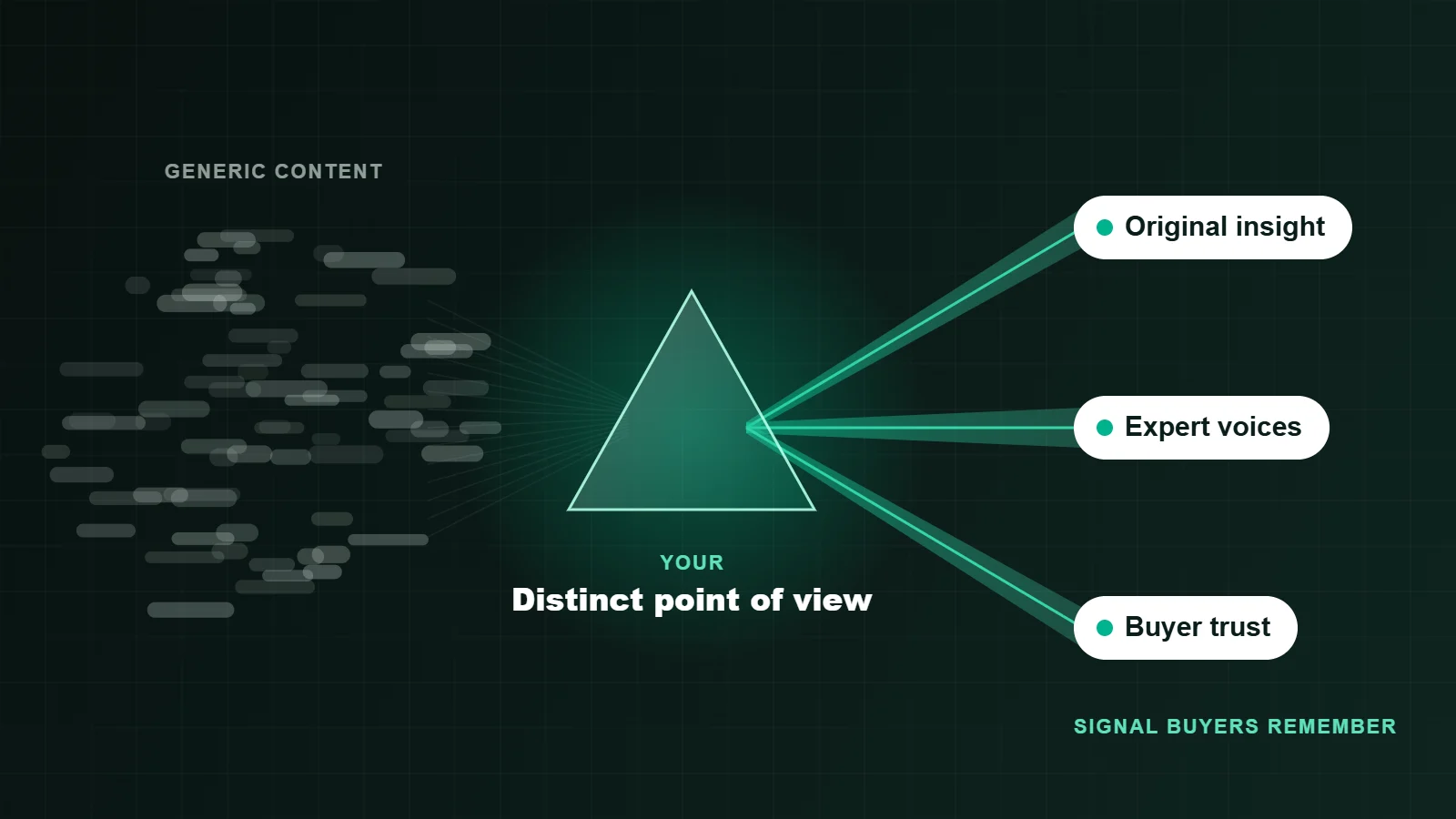
Thought leadership marketing is the practice of earning trust by publishing original, useful ideas that help your buyers think more clearly about their problems. Instead of promoting a product directly, a company shares a distinct point of view, real expertise, and evidence, so that when buyers are ready to act, they already see that company as the credible choice.
For B2B technology companies, this matters more than in almost any other market. Sales cycles are long, buying committees are large, and the people evaluating a product are often experts themselves. They do not respond to slogans. They respond to proof that a team understands their world better than anyone else.
The short answer: Thought leadership marketing turns a company’s expertise into a clear point of view, publishes it consistently where buyers pay attention, and builds the trust that makes every later sales conversation easier.
Want help building a thought leadership program? See how CaliberUp approaches thought leadership and technical content for technical companies.
What Is Thought Leadership Marketing?
A thought leader is a person or company that others turn to for a trusted perspective on where a field is heading and how to handle its hardest problems. Thought leadership marketing is the deliberate work of becoming that source: choosing the ideas you want to be known for, backing them with real expertise and evidence, and putting them in front of the people who matter to your business.
Three ingredients separate genuine thought leadership from ordinary marketing content:
- A point of view. It takes a position. It explains what the company believes is true, what others get wrong, and what buyers should do differently.
- Earned expertise. It draws on things only your team knows: customer patterns, technical depth, data, or hard-won experience.
- Usefulness without a pitch. It helps the reader even if they never buy. The commercial value comes from the trust it creates, not from a call to action.
Thought Leadership vs Content Marketing
Thought leadership is a type of content marketing, but not all content marketing is thought leadership. Most content answers questions buyers already know to ask. Thought leadership changes the questions they ask.
| Content marketing | Thought leadership | |
|---|---|---|
| Main goal | Attract and educate buyers, capture demand | Shape how buyers see the problem, create demand |
| Typical question | “How do I do X?” | “Why is X changing, and what should we do about it?” |
| Source of value | Clear, complete answers | Original insight, data, or a distinct perspective |
| Voice | Brand voice | Often a named executive, expert, or research team |
| Time horizon | Search traffic and leads in weeks to months | Reputation and pipeline influence over months to years |
The strongest programs use both. Practical guides capture people who are already searching, and thought leadership gives them a reason to remember you and trust your recommendations.
Why Thought Leadership Matters in B2B Tech
- Buyers decide before they talk to sales. Most research happens independently. If your thinking is not part of that research, you enter the conversation late, often competing on price.
- Buying committees need shared conviction. Engineers, executives, finance, and security all need reasons to say yes. A clear, well-argued point of view gives an internal champion something to forward.
- Complex products need context. New categories and deep-tech products are hard to evaluate. Thought leadership explains why the problem matters before the product explains how it is solved.
- Trust compounds. A single article rarely closes a deal, but a consistent body of credible work makes every sales call, partnership, hiring conversation, and fundraising meeting easier.
- It differentiates when features converge. Competitors can copy features. They cannot easily copy a team’s insight, experience, and reputation.
6 Types of Thought Leadership Content
Thought leadership is defined by the quality of the idea, not the format. These are the formats that work best for technical B2B companies.

1. Point-of-view articles and essays
A clear argument about where the industry is going, what conventional wisdom gets wrong, or how buyers should rethink a decision. These are the backbone of most programs because they are fast to produce and easy to share.
2. Original research and data
Surveys, benchmarks, usage data, or analysis of a public dataset. Original numbers are among the most cited and linked forms of content because nobody else has them. Even a small, well-designed study can become a reference point for an entire niche.
3. Executive and founder-led content
LinkedIn posts, bylined articles, op-eds, and newsletters published under a named leader. People trust people more than logos, and a founder who explains the problem with conviction often reaches buyers a company page never will.
4. Technical deep dives
Architecture explanations, engineering lessons, honest trade-off analyses, and benchmark methodology. For technical audiences, this is often the most persuasive thought leadership of all, because it proves competence instead of claiming it.
5. Frameworks and models
A simple model that helps buyers make a decision, such as a maturity model, an evaluation checklist, or a cost framework. Good frameworks get reused in internal presentations, which carries your thinking into meetings you are not in.
6. Talks, podcasts, and events
Conference talks, webinars, panels, and podcast appearances extend your ideas beyond the page and put a human voice behind them. A single strong talk can be repurposed into articles, clips, and posts for months.
How to Build a Thought Leadership Strategy in 7 Steps
- Define the audience precisely. Name the roles, industries, and buying stages you want to influence. “CTOs at mid-size manufacturers evaluating AI quality inspection” produces far sharper ideas than “technology leaders.”
- Find your point of view. Interview your founders, engineers, and customer-facing teams. Look for beliefs you hold that the market does not yet share, mistakes you see buyers make repeatedly, and patterns only you can see in your data.
- Choose two to four themes. Themes are the territory you want to own. Each should connect to a problem your product solves, without being about your product.
- Pick your voices. Decide who speaks: a founder, a technical leader, a research team, or the company brand. Consistent named voices build recognition faster than anonymous content.
- Select formats and a realistic cadence. One excellent piece per month beats four forgettable ones. Plan a flagship asset per quarter, such as a report or deep dive, and smaller pieces that extend it.
- Plan distribution before production. Decide where each piece will live and how it will reach people: owned channels, executive profiles, newsletters, partners, media, events, and sales outreach.
- Measure, learn, and refine. Track what resonates with the right audience, listen to what sales hears in calls, and sharpen your themes every quarter.
If your positioning is still unclear, start there. Thought leadership amplifies a point of view; it cannot invent one. Our guide to product marketing explains how positioning and messaging are built.
What Good Thought Leadership Looks Like: Examples by Type
Rather than list famous brands, here are the patterns that consistently work for technical companies, and what makes each one effective.
- The category-defining essay. A founder explains why an old approach is breaking down and names the new problem clearly. It works because it gives buyers language for something they felt but could not describe.
- The annual benchmark report. A company publishes performance or adoption data from its domain every year. It works because it becomes a recurring reference journalists, analysts, and buyers cite.
- The honest engineering post-mortem. An engineering team explains what failed, why, and what they changed. It works because candour signals competence, and technical buyers notice.
- The buyer’s evaluation guide. A practical framework for choosing a solution, including criteria that do not favour the author. It works because fairness builds trust at the exact moment a decision is made.
- The executive newsletter. A short, regular note from a leader interpreting industry news through a consistent lens. It works because repetition builds familiarity and a habit of reading.
Distribution: Where Thought Leadership Earns Attention
Great ideas do not spread on their own. Plan to spend as much effort on distribution as on creation.

- Your website and blog. The permanent home for flagship pieces, where they can rank in search and support sales.
- Executive LinkedIn profiles. Often the highest-reach channel in B2B. Post original takes, not just links.
- Email newsletters. The most reliable way to stay in front of an audience you own.
- Media, bylines, and podcasts. Borrow established audiences and gain third-party credibility.
- Events and webinars. Turn ideas into live conversations and relationships.
- Sales enablement. Give your sales team the best pieces to share at the right stage of a deal. This is where thought leadership most directly influences revenue.
Repurpose deliberately: one research report can become a launch article, a webinar, a series of executive posts, a sales one-pager, and a conference talk.
How to Measure Thought Leadership
Thought leadership influences decisions over time, so measure it with a mix of leading and lagging signals rather than last-click leads alone.
| What to measure | Example signals |
|---|---|
| Reach with the right audience | Engagement from target accounts and roles, newsletter growth, follower quality |
| Authority | Backlinks, media mentions, speaking invitations, citations in AI answers |
| Brand demand | Growth in branded and executive-name searches, direct traffic |
| Pipeline influence | Content consumed by opportunities, deals where prospects reference your ideas |
| Sales feedback | How often prospects arrive already educated and aligned with your point of view |
Ask new customers what they read or heard before contacting you. Qualitative answers are often the clearest evidence that thought leadership is working.
Common Thought Leadership Mistakes
- Restating the obvious. If a piece could have been written by any company in your category, it is not thought leadership.
- Disguised sales pitches. Readers notice quickly when an “insight” is a product brochure. It costs trust instead of earning it.
- No clear owner or voice. Content written by committee loses its edge. Give each piece a real author and a real opinion.
- Chasing trends without expertise. Commenting on every hot topic dilutes your authority. Stay close to the themes you can credibly own.
- Publishing without distribution. A strong idea that nobody sees has no impact.
- Quitting too early. Reputation compounds. Most programs need several quarters of consistent output before the effects are obvious.
Thought Leadership in the Age of AI Search
Buyers increasingly ask AI assistants to summarize options and explain complex topics. Those assistants draw on content that is specific, well-structured, and widely referenced. Generic articles are easy to replace with an AI summary; original data, clear frameworks, and expert perspectives are what get cited.
That makes thought leadership more valuable, not less. Publish clearly attributed expertise, answer real buyer questions in depth, and earn mentions from credible sources. The same qualities that build trust with human readers also make your ideas more likely to appear in AI-generated answers.
Frequently Asked Questions About Thought Leadership Marketing
What is thought leadership marketing in simple terms?
It is sharing original, useful expertise and a clear point of view so that your target buyers see your company as a trusted authority. The goal is to build credibility and trust that make buying from you feel like the obvious choice.
What is the difference between thought leadership and content marketing?
Content marketing answers the questions buyers already ask, such as how-to guides and explainers. Thought leadership offers a distinct perspective, original data, or new frameworks that change how buyers think about a problem. Thought leadership is a more ambitious subset of content marketing.
Who should be the thought leader: the company or the founder?
Usually both. Named people, especially founders and technical leaders, build trust faster, while the company brand provides a permanent home and consistency. Many B2B tech companies pair a founder-led voice on LinkedIn with research and deep dives published under the brand.
How long does thought leadership take to work?
Some pieces earn attention quickly, but meaningful reputation usually builds over several quarters of consistent publishing. Expect early signals such as engagement from target accounts and sales feedback before measurable pipeline impact.
How do you measure the ROI of thought leadership?
Combine signals: engagement from target accounts, branded search growth, backlinks and media mentions, content consumed by open opportunities, and what new customers say influenced them. Thought leadership rarely shows up in last-click attribution, so qualitative evidence matters.
Can a small or early-stage company do thought leadership?
Yes. Small companies often have an advantage: founders with deep expertise and a sharp point of view. One strong article a month, consistent executive posting, and a single original data project can establish real authority in a focused niche.