
Insights / Product Marketing
What Does a Product Marketing Manager Do? Role, Responsibilities and Skills
A practical guide to the product marketing manager role: what PMMs own, how their work changes before and after launch, how they differ from product managers, the skills that matter, and when a company should hire one.
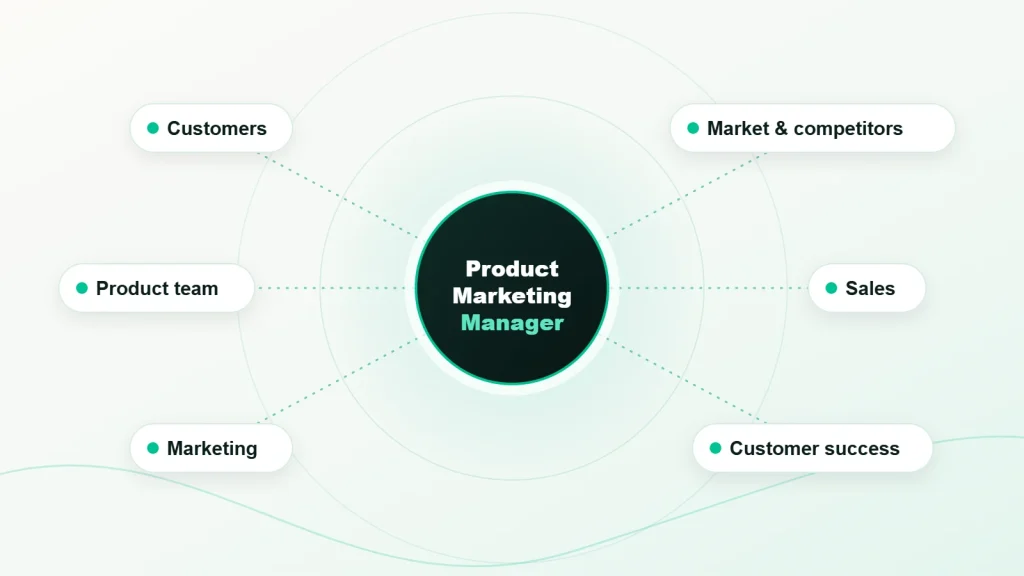
A product marketing manager (PMM) decides who a product is for, why those customers should choose it, and how the company will bring it to market. In practice, a PMM researches buyers and competitors, writes the positioning and messaging, plans launches, equips sales to win deals, and feeds what the market says back into the product.
The role sits at the intersection of product management, marketing, sales, and customer success. That is why it is often misunderstood: a PMM is not the person who runs ads or posts on social media, and not the person who decides what gets built. A PMM owns the bridge between the two, making sure that what the company builds is understood, chosen, and adopted by the right customers.
The short answer: A product marketing manager turns market evidence into positioning, messaging, launches, and sales tools, then uses what customers and deals reveal to improve both the product and the story around it.
New to the discipline itself? Start with our guide to what product marketing is, then come back for a closer look at the people who do it.
What Is a Product Marketing Manager?
A product marketing manager is the person accountable for a product’s market understanding, positioning, go-to-market execution, and adoption. Where a product manager asks “what should we build?”, a product marketing manager asks “who is this for, why will they choose it, and how do we win them?”
The title varies. Depending on the company, the same work may sit with a product marketing manager, a senior or principal PMM, a go-to-market lead, a solutions marketer, or, at an early-stage startup, a founder. The responsibilities are what define the role, not the title. If you want the broader context of the discipline these people practice, our complete guide to product marketing covers the full lifecycle.
What Does a Product Marketing Manager Do? 8 Core Responsibilities
The exact scope depends on the company, but most product marketing managers spend their time across the same eight areas.

1. Understand the market, buyers, and customers
Everything a PMM produces starts with evidence. That means customer and prospect interviews, win-loss analysis, reviewing sales calls, studying how buyers describe their problem, and segmenting the market into groups that buy for different reasons. The output is a clear picture of the ideal customer profile, buyer personas, buying committee, and the jobs customers are trying to get done.
2. Define positioning and messaging
Positioning answers four questions: who the product is for, what category it competes in, what makes it different, and why that difference matters. Messaging turns that position into language: a value proposition, key messages for each audience, proof points, and the words sales, marketing, and the website should use. A good PMM tests messaging with real buyers instead of approving it in a conference room.
3. Plan go-to-market strategy and launches
PMMs decide how a product or feature reaches the market: which segments to target first, which channels matter, what the launch tier should be, and what every team needs to do and when. For a major launch, the PMM is usually the person coordinating product, marketing, sales, support, and leadership around one plan and one story.
4. Enable sales
In B2B companies, sales enablement is often where a PMM has the most visible impact. That includes pitch decks, demo narratives, battlecards, objection handling, discovery questions, case studies, and training. The test is simple: can a sales rep explain the product’s value, handle the hardest objections, and win against the main competitors without calling the product team?
5. Track competitors and the market
PMMs maintain competitive intelligence: how alternatives position themselves, where they win and lose, how they price, and what changed recently. This feeds battlecards, messaging, and product decisions. The goal is not to copy competitors but to know precisely where your product is the better choice and for whom.
6. Shape pricing and packaging
PMMs rarely set prices alone, but they usually bring the market evidence to pricing and packaging decisions: what customers value, how they compare options, what they expect to pay for, and how tiers or editions should be structured around real buying behavior.
7. Drive adoption, retention, and expansion
Product marketing does not end at the sale. PMMs work on onboarding messages, feature adoption campaigns, customer education, and the story that helps existing customers expand. If customers buy but never reach value, a product marketer treats that as a positioning or enablement problem worth solving.
8. Bring the voice of the customer back to product
Because PMMs talk to buyers, sales, and customers constantly, they are well placed to tell product teams what the market actually needs. Structured feedback from win-loss reviews, objections, churn reasons, and feature requests helps the roadmap reflect real demand instead of the loudest opinion.
Need this work done for a complex technical product? CaliberUp’s product marketing services cover positioning, messaging, launches, and sales enablement for technology companies.
How a Product Marketing Manager’s Work Changes Across a Launch
One useful way to understand the role is to follow a single product or major feature from research to growth. The focus shifts at each stage, but the PMM owns the thread that connects them.
| Stage | What the PMM focuses on | Typical outputs |
|---|---|---|
| Before launch | Researching the market, defining the target customer, testing positioning, planning go-to-market | Customer research summary, ICP and personas, positioning statement, messaging framework, launch plan |
| Launch | Aligning every team on one story and making sure customers and sales can act on it | Website and launch content, sales deck and demo narrative, battlecards, internal training, announcement |
| After launch | Measuring what is working, removing friction, and learning from deals and customers | Win-loss insights, adoption campaigns, updated messaging, customer stories, input to the roadmap |
Product Marketing Manager vs Product Manager vs Marketing Manager
These three roles are the most often confused. They work closely together, but each owns a different question.
| Role | Primary question | Typical ownership |
|---|---|---|
| Product marketing manager | Who is it for, why will they choose it, and how will we win them? | Market research, positioning, messaging, go-to-market, launches, sales enablement, adoption |
| Product manager | What should we build, and in what order? | Product vision, roadmap, requirements, prioritization, delivery with engineering |
| Marketing manager | How do we reach the audience and create demand? | Campaigns, channels, content programs, events, lead generation, brand activity |
In short: the product manager owns the product, the marketing manager owns reach and demand, and the product marketing manager owns the market’s understanding of the product. When one of the three is missing, the others usually end up covering it, often without the time or evidence to do it well.
Skills a Good Product Marketing Manager Needs
- Customer research. Running interviews that uncover real motivations, and turning messy findings into clear decisions.
- Strategic thinking. Choosing a segment and a position, which means deciding what not to say and who not to target.
- Writing and storytelling. Explaining complex value in plain language that a buyer remembers and repeats.
- Product fluency. Understanding the product well enough to earn credibility with engineers and to explain trade-offs honestly.
- Cross-functional leadership. Getting product, sales, marketing, and support to move together without formal authority over any of them.
- Commercial judgment. Knowing how deals are won and lost, and what actually changes a buyer’s decision.
- Analytical skills. Reading win rates, adoption data, and funnel metrics to see what is working and why.
How Product Marketing Managers Are Measured
Because PMMs influence outcomes owned by several teams, good measurement combines leading indicators with business results. Common metrics include:
- Win rate, overall and against key competitors
- Sales cycle length and deal size for the segments the PMM targets
- Pipeline and revenue influenced by launches and enablement
- Product adoption of launched features and time to value
- Retention and expansion in target segments
- Message effectiveness, such as website conversion, content engagement, and how consistently sales uses the messaging
The most useful metrics are agreed with sales and product leadership up front, so the PMM is measured on the outcomes the company actually cares about rather than on the volume of materials produced.
How the Role Changes by Company Stage
Early-stage startups
Product marketing is often handled by a founder. The work is about finding the first repeatable position: which customers feel the problem most, what they compare you to, and which message makes them take a meeting. The first product marketer, when hired, is usually a hands-on generalist who does research, writes the website, and builds the first sales materials.
Scale-ups
As the sales team and product line grow, PMMs focus on consistency and leverage: a messaging framework every team uses, repeatable launches, solid sales enablement, and competitive programs. Roles may split by product line, segment, or function.
Enterprises
Large companies often have specialized product marketing teams covering market research, competitive intelligence, pricing, industry or solutions marketing, and launches. The challenge shifts toward coordination: keeping many products, regions, and teams telling a coherent story.
What Changes for Technical and Deep-Tech Products
For complex products, such as AI infrastructure, developer platforms, hardware, or enterprise systems, the product marketing manager role carries a few extra demands:

- Multiple buyers with different questions. Engineers evaluate how it works, executives evaluate why it matters, and procurement evaluates risk. Messaging has to work for each without contradicting itself.
- Credibility before persuasion. Technical buyers discount vague claims. Benchmarks, architecture explanations, and honest trade-offs often persuade better than adjectives.
- Long, evidence-driven sales cycles. Whitepapers, technical guides, and proof-of-concept support matter as much as the homepage.
- Translation in both directions. The PMM has to understand the engineering deeply enough to explain it simply, and understand the market well enough to explain it back to engineers.
This is the gap CaliberUp works in: product marketing for companies whose technology is hard to explain. Our technical thought leadership and product marketing services are built for exactly these situations.
When Should a Company Hire a Product Marketing Manager?
Common signs that a company needs dedicated product marketing:
- Sales explains the product differently from rep to rep, and win rates are inconsistent.
- Prospects understand the features but cannot say why they should choose you over an alternative.
- Launches ship, but few customers notice or adopt what was released.
- The website describes what the product does but not who it is for or why it matters.
- Product decisions are driven by internal opinion more than by structured market evidence.
- Founders or product managers are spending a growing share of their time on messaging and sales support.
There are three common ways to get this capability:
- Hire a full-time PMM when product marketing is a permanent, high-volume need and you can give the role clear ownership.
- Bring in a fractional product marketer or strategist when you need senior judgment without a full-time hire. See our strategic growth partner model.
- Work with a product marketing agency when you need a team to deliver positioning, messaging, launches, and enablement quickly, especially for technical products.
Not sure which option fits your stage? Talk to CaliberUp about your product, your market, and where go-to-market is getting stuck.
Frequently Asked Questions About Product Marketing Managers
What does a product marketing manager do day to day?
A typical week mixes customer and sales conversations, writing or refining messaging, building sales materials, planning upcoming launches, reviewing competitor changes, and working with product teams on what is coming next. The balance shifts depending on whether a launch is approaching.
Is a product marketing manager the same as a product manager?
No. A product manager decides what gets built and works with engineering to deliver it. A product marketing manager decides who the product is for, how it is positioned, and how it reaches and wins customers. The two roles work closely together.
Is product marketing a marketing role or a product role?
Both. Product marketing usually reports into marketing, but the work depends heavily on product knowledge and close collaboration with product and sales teams. It is best understood as the bridge between them.
What are the most important deliverables of a PMM?
Positioning and a messaging framework, buyer personas and an ideal customer profile, launch plans, sales enablement materials such as decks and battlecards, competitive intelligence, and customer insight shared back with product.
Do startups need a product marketing manager?
Early on, founders usually do product marketing themselves. Dedicated help becomes valuable once there is a sales team to enable, regular launches to plan, or a product that buyers struggle to understand. Many startups start with fractional or agency support before hiring full time.
How is a product marketing manager different from a marketing manager?
A marketing manager focuses on reaching audiences and generating demand through campaigns and channels. A product marketing manager defines what the market should understand about the product and why it should care, which gives those campaigns their message.
The Product Marketing Manager Connects the Product to the Market
A product marketing manager makes sure the right customers understand why a product matters to them, and that every team tells that story the same way. The best PMMs combine research, strategy, writing, and commercial judgment, and they keep learning from the market long after launch.
For technical companies, that role is often the difference between a product that is admired and a product that is bought. If you are deciding how to build that capability, start with the evidence: how buyers describe their problem today, and where your current story loses them.
Sources and further reading
This guide draws on established product-marketing role definitions and frameworks. Useful companion references include: